
The Push-Back Protocol: Teaching Students to Challenge AI, Not Accept It
How a structured framework for critical evaluation transforms AI from a thinking substitute into a thinking partner

A student recently asked me an intriguing question: “Is AI making it harder for me to think critically, even while it’s helping me write better?”
Now, I know this student. She is exceptionally bright, a model student, diligent in completing her work, and she has always done fantastic work. She wasn’t being rhetorical. She genuinely wanted to know. And in asking, she demonstrated the very capacity she was worried about losing.
Her question captures the central paradox of generative AI in education. The outputs get better. The prose flows more smoothly. The arguments appear more polished. But something feels different in the process, and we are all seeing the difference. Students are producing stronger work while sensing they’re doing less of the cognitive heavy lifting to get there.
This student had the metacognitive awareness to name what many of her peers experience without articulating. She could feel the difference between generating ideas through struggle and receiving them through suggestion. And she was right to be concerned.
The Research Confirms Intuition
Recent research supports what this student sensed instinctively. In a case study of 118 postgraduate management students at a UK business school, students’ reflections on generative AI use showed a strong tilt toward writing support (paraphrasing, rephrasing, polishing) rather than sustained critical sensemaking. Only a minority demonstrated what the researcher described as more advanced sensemaking: the deeper work of evaluating, synthesizing, and forming independent judgments.
The pattern also shows up in higher education teaching syntheses. Duke’s Learning Innovation & Lifetime Education (LILE) notes findings that students using large language models for writing and research tasks may experience reduced cognitive load while showing weaker reasoning and argumentation than peers using more traditional approaches, and that AI use can narrow idea exploration in ways that produce more biased and superficial analyses.
The mechanism isn’t mysterious. When AI provides confident, well-formatted responses, students face an unconscious cost-benefit calculation. Verifying and pushing back requires effort. Accepting requires almost none. And educational systems have spent years training students to optimize for acceptable outputs rather than genuine inquiry. AI doesn’t invent that tendency. It reveals it—and amplifies it.
The “Looks Good” Problem
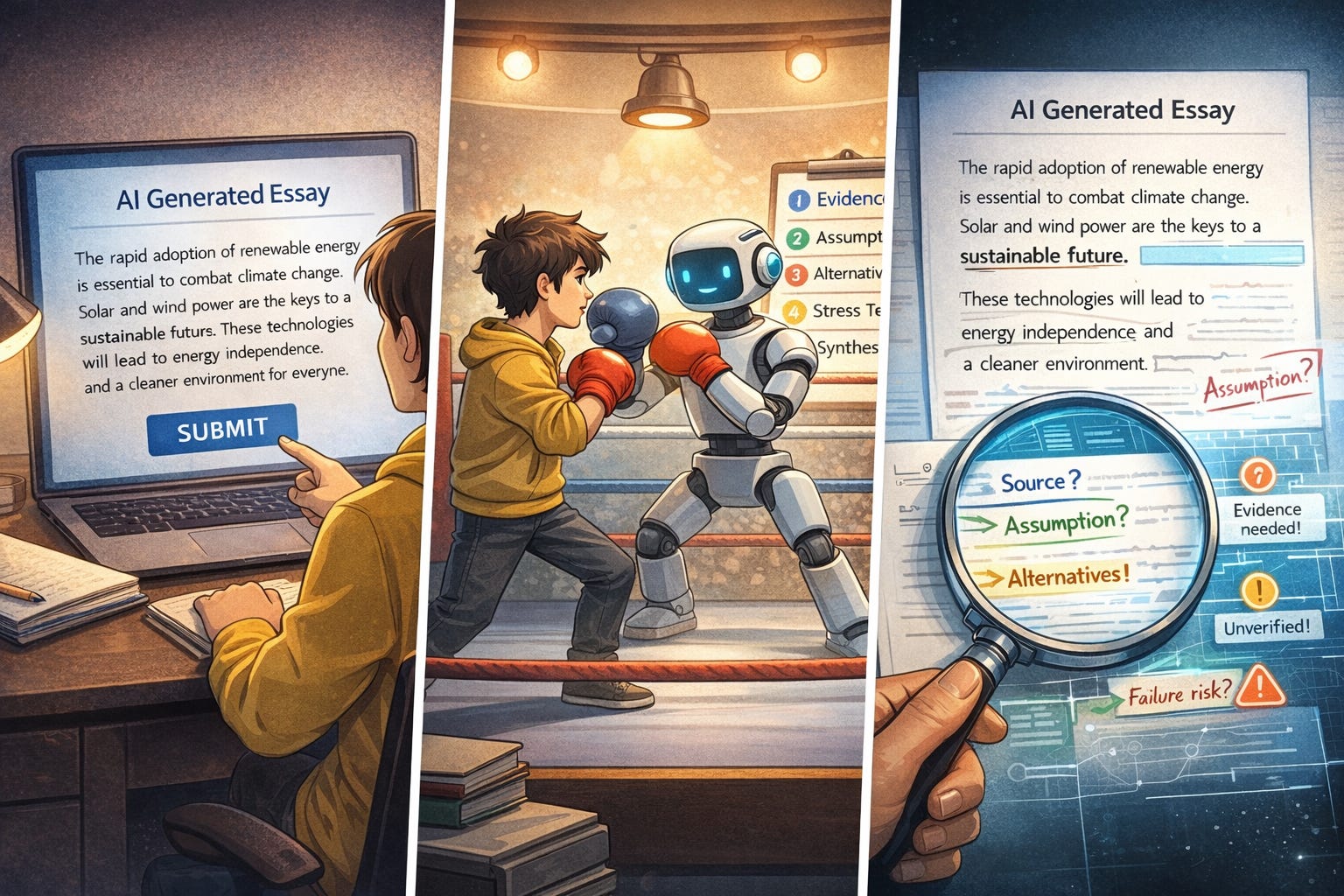
Here’s the scene that plays out in learning everywhere today: a student prompts an AI tool for help with an assignment. The response appears on screen, paragraphs of smooth prose with clear structure and apparent logic. The student scans it, nods, and thinks, “That looks pretty good.” Minor edits follow, perhaps a word change here, a sentence rearranged there. Then submit.
What’s missing from this workflow is the cognitive work that produces learning. No wrestling with competing ideas. No confronting the limits of one’s own understanding. No productive confusion that precedes genuine insight. The output may be acceptable, even impressive, but the development that should accompany it never occurs.
This is what I call the accept-and-submit pattern, and it represents a fundamental misunderstanding of what AI partnership should look like. Students aren’t failing to use AI well because they lack technical skills. They’re failing because no one has taught them that the first response is just the beginning of the conversation, not the end.
Introducing the Push-Back Protocol
The solution isn’t to ban AI or to pretend students won’t use it. The solution is to design learning and structure AI interaction in ways that require and develop critical thinking.
I call this approach the Push-Back Protocol, a five-round framework that transforms passive acceptance into active evaluation.
The protocol begins with a simple premise: every AI output is a first draft that deserves scrutiny, not a finished product that deserves trust. Students learn to treat AI responses the way a seasoned editor treats a manuscript or a rigorous peer reviewer treats a research paper. The goal isn’t to reject what AI produces but to refine it through sustained intellectual engagement.
Round One: Generate and Demand Evidence
The process starts conventionally. Students prompt AI for a first draft on their topic. But instead of accepting what appears, they immediately push back with a demand for evidence:
“Defend your choices. What sources support these claims? What’s your confidence level in each assertion?”
This round accomplishes two things. First, it surfaces the difference between confident-sounding prose and actually supported claims. AI systems often present information with equal certainty regardless of evidential backing. Forcing the tool to defend itself reveals where that confidence is warranted and where it’s manufactured.
Second, it establishes from the outset that the student is the evaluator, not the recipient.
One crucial caveat belongs here: AI-generated citations and “confidence levels” are not evidence. They’re leads. Students must verify claims using credible sources (e.g., library databases, primary documents, or peer-reviewed research) because large language models can produce plausible-looking references that don’t hold up.
Round Two: Surface and Question Assumptions
Every argument rests on assumptions, and AI-generated content is no exception. In this round, students examine the output for unstated premises:
“What assumptions are you making here? What would have to be true for this argument to hold? What perspectives or contexts are you not considering?”
Students often discover that AI outputs assume particular audiences, value systems, or contextual factors that may not match their actual situation. A business recommendation might assume growth is the primary goal. A policy analysis might assume certain stakeholders matter more than others. Making these assumptions visible gives students the opportunity to accept, reject, or modify them deliberately.
This is also the moment to get honest about bias. AI systems can reproduce stereotypes and distortions, especially when describing learners from diverse backgrounds or when a “default” narrative quietly centers dominant cultural norms. Stanford HAI has highlighted how LLM outputs can reinforce harmful stereotypes in educational contexts, which makes assumption-checking not just academic rigor, but an equity practice.
Round Three: Request Alternative Perspectives
This round introduces what might be called reverse prompting. Instead of the student asking only for answers, they invite the AI to widen the lens and interrogate the frame:
“Is there another way to look at this issue? What questions should I be asking that I haven’t asked? What would someone who disagrees with this position say?”
The goal is to break students out of confirmation bias and premature closure. When AI presents a coherent argument, it’s tempting to accept that framing as the framing. Explicitly requesting alternatives reminds students that any complex topic admits multiple valid perspectives, and their job is to navigate among them thoughtfully rather than to accept the first coherent option.
To keep this from becoming a purely Western “debate club” exercise, I explicitly add: “Now do this from a non-U.S. context.” Different regulatory environments, different social norms, different power dynamics, different histories. Critical thinking gets stronger when it has to travel.
Round Four: Stress Test
Before finalizing anything, students subject the refined output to adversarial examination:
“What could go wrong if we implemented this recommendation? What are the weakest points in this argument? Where might this analysis fail in practice?”
This round develops the habit of anticipating objections rather than being surprised by them. It also builds the kind of risk awareness that matters in professional contexts. Leaders who accept recommendations without stress-testing them expose their organizations to avoidable failures. Students who learn to stress-test AI outputs develop judgment that transfers beyond the classroom.
There’s also a research-backed logic here. Human-computer interaction research shows that people often over-rely on AI recommendations (even when the system is wrong) and that adding more “explanations” doesn’t reliably fix the problem. What does help is forcing the user into deeper engagement through structured interventions, what researchers call cognitive forcing functions.
That is the heartbeat of this protocol: not “trust me,” not “trust the AI,” but “do the thinking.”
Round Five: Synthesize and Reflect
The final round asks AI to integrate everything from the previous rounds into a revised response. But the process doesn’t end there. Students then write their own synthesis, comparing the original output to the refined version and articulating their human judgment about what changed, what improved, and what they learned.
This reflection component is essential. Without it, the protocol remains a series of prompts rather than a developmental experience. With it, students build metacognitive awareness of their own thinking processes and begin to internalize the evaluative stance the protocol teaches.
A Quick Example: What “Push Back” Looks Like in Real Life
Imagine a student asks AI: “Should cities ban single-use plastics?” The AI delivers a neat, persuasive argument for a ban. It looks good.
Round One forces evidence: Which studies show bans reduce pollution? What happens to low-income consumers if costs rise?
Round Two surfaces assumptions: Are we assuming enforcement is feasible? That alternatives are accessible? That harm is evenly distributed?
Round Three requests alternative perspectives: What would small businesses say? Disability advocates who rely on certain packaging? What about places where waste infrastructure is different?
Round Four stress-tests: What unintended consequences happen—black markets, substitution to heavier materials, increased emissions?
Round Five synthesizes, and the student writes a reflection: “The initial answer treated this as a simple moral issue. The revised version made it a systems problem.”
That’s the learning.
The Push-Back Log: Making Thinking Visible
The deliverable for this process isn’t just a final product. It’s documentation of the journey.
Students submit a Push-Back Log that includes the original AI output, each challenge prompt and response, and their final human reflection comparing where they started to where they ended.
This log serves multiple purposes. For assessment, it makes the intellectual work visible in ways that final products alone cannot. Educators can see where students pushed hard and where they accepted too easily. For learning, the log creates an artifact students can review, helping them recognize patterns in their own critical evaluation over time. For accountability, it establishes that AI was used as a partner in thinking rather than a substitute for it.
Some educators worry that requiring such documentation creates busywork. The opposite is true. The documentation is the learning. Without it, the cognitive work of evaluation remains invisible and is easily skipped. With it, students must actually do the thinking the protocol demands.
Why This Works
The Push-Back Protocol succeeds because it addresses the root cause of uncritical AI acceptance: the path of least resistance leads to passive consumption. By structuring multiple rounds of required interaction, the protocol makes critical evaluation the path itself. Students can’t complete the assignment without doing the thinking.
It also helps students develop what researchers call appropriate reliance: calibrated trust that allows someone to accept helpful AI contributions while rejecting flawed ones. The goal isn’t overreliance (treating AI as an authority) or underreliance (rejecting it reflexively). It’s judgment.
One practical note: students differ in how naturally they engage effortful thinking, and structured “forcing” designs can benefit some learners more than others. That doesn’t weaken the protocol—it clarifies the design task for educators. The structure needs to be explicit, teachable, and supported, not assumed.
Beyond AI Literacy
The deeper value of the Push-Back Protocol extends beyond AI interaction. Students who learn to challenge AI outputs become better at challenging all information sources. The skills transfer: demanding evidence, surfacing assumptions, seeking alternative perspectives, stress-testing recommendations. These are the core competencies of critical thinking regardless of whether the source is artificial or human.
In an information environment increasingly shaped by AI-generated content, this generalized skepticism matters more than ever. Students will encounter AI outputs they don’t know are AI outputs. They’ll receive recommendations from systems whose reasoning is opaque. They’ll make decisions based on analyses whose assumptions are hidden. The evaluative habits built through the Push-Back Protocol prepare them for all of these encounters.
This is also, fundamentally, character development. Critical evaluation is a virtue, a stable disposition to engage thoughtfully with information rather than to accept it passively. Like all virtues, it develops through practice. The Push-Back Protocol provides structured practice in environments where the stakes are low enough to allow experimentation but high enough to matter for grades and learning.
The Other Side: Students Who Won’t Use AI at All
Not every student falls into the accept-and-submit pattern. Some swing to the opposite extreme. They refuse to use AI at all, worried that any assistance will compromise their learning.
This concern deserves respect. These students are right that cognitive struggle produces learning, and they’re right to be suspicious of tools that might short-circuit that struggle. Their instinct to protect their own development is healthy.
But complete avoidance isn’t the answer either, for two reasons.
First, AI tools are becoming embedded in professional workflows across nearly every field. Students who graduate without experience using these tools thoughtfully will find themselves at a disadvantage, forced to learn AI collaboration on the job without the scaffolding that education can provide.
Second, and more importantly, the choice isn’t binary. The real question isn’t whether to use AI but how to use it in ways that preserve—and even enhance—the cognitive work that produces learning. This is where thoughtful course design matters.
Structuring the Balance
Instructors can design learning activities that honor both concerns: the need for genuine cognitive engagement and the reality that AI will be part of students’ professional futures.
The key is separating phases of work and being explicit about what each phase is for. In the generation phase, students might work independently, wrestling with ideas before bringing AI into the conversation. This preserves the productive struggle that builds understanding. In the refinement phase, AI becomes a sparring partner—someone to argue with, challenge, and push back against. The cognitive work continues, but now it’s the work of evaluation rather than generation.
Instructors can also designate certain assignments as AI-free zones while opening others to structured AI collaboration. A first draft might be written independently; the revision process might involve AI as a critical reader. An initial analysis might require students to form their own conclusions; a subsequent stress-test might use AI to surface counterarguments. The balance shifts depending on which skills the assignment is designed to develop.
One more adoption-friendly reality: this doesn’t have to be an all-or-nothing, five-round epic every time. Some instructors start with a 10-minute “two-round” version (evidence + assumptions) and scale up as students gain skill. The point isn’t the number of rounds. The point is the stance: the student evaluates; the AI proposes.
Answering the Student’s Question
So what did I tell that student who asked whether AI was making it harder for her to think critically?
I told her that her question itself was evidence of critical thinking in action. The capacity to reflect on one’s own cognitive processes, to notice changes in how one’s mind works, and to evaluate whether those changes are desirable is precisely what we mean by metacognition. AI didn’t steal that from her. If anything, AI gave her something to think critically about.
I told her that AI can erode critical thinking, but only if she lets it. The erosion happens through passive acceptance, through the accept-and-submit pattern that treats AI as an oracle rather than a collaborator. It doesn’t happen when she pushes back, questions, challenges, and ultimately decides for herself what to think.
I told her that the discomfort she feels is actually useful data. It’s the sensation of noticing a potential trap before falling into it. Students who never feel that discomfort are the ones most at risk, because they’re accepting AI outputs without the metacognitive awareness to recognize what they’re giving up.
And I told her about the Push-Back Protocol. Not as a complete solution, but as a practice. A way to structure her AI interactions so that they develop her thinking rather than replace it. A method for transforming the tool from a shortcut that bypasses cognition into a sparring partner that strengthens it. Even without an instructor designing the structure, she could practice it on her own.
AI will be part of how students learn and work. The question is whether we’ll teach them to use it in ways that build their capacities or diminish them. The Push-Back Protocol represents one answer to that question: a structured approach to critical AI collaboration that treats every interaction as an opportunity for intellectual development.
The student who asked me that question is already ahead of most of her peers. She’s paying attention to her own mind. Now she needs tools to act on what she’s noticed. That’s what we owe her, and that’s what education in the AI age demands.
This is fantastic. Will restack
Your framework positions critical evaluation not as deficit but as structural engagement with AI output.
Does this framing change how students internalize patterns of reasoning versus pattern imitation?